9 Best Electric Meat Slicers for Home Use (November 2026)
The best electric meat slicers for home use include the NutriChef Electric Carving Turkey Slicer Kitchen Knife for holiday carving, the OSTBA Electric Meat Slicer with Two 7.5” for deli meat at home, and the VEVOR Meat Slicer for frozen meat and ham.
On this page (10 sections)
- Which electric meat slicer for home use fits your kitchen
- The best electric meat slicers for home use, ranked
- How do these electric meat slicers compare side by side
- How we compared these models
- What blade size should you choose for home use
- How thick can you slice deli meat and cheese
- How do you clean and store a meat slicer safely
- Which slicer is best for jerky and small spaces
- What about canning and storage after slicing
- Our verdict on the best electric meat slicer for home use
The best electric meat slicer for home use depends on the job you do most. For a true deli slicer on your counter, the OSTBA 7.5 inch model is the top pick here.
For holiday carving, the NutriChef electric knife is easier to store and use at the table. We compared 9 models by blade size, power, thickness range and cleaning, with scores based on specs, features and buyer feedback.
If you want a broader view of related tools, our meat grinder buying guide covers the next step for ground meat. For home-only options, see our best home meat slicer guide.
Our picks at a glance
-
1
 Best for holiday carving
NutriChef Electric Carving Turkey Slicer Kitchen Knife
9.7/10 our score
See it on Amazon -
2
 Best for deli meat at home
OSTBA Electric Meat Slicer with Two 7.5”
9.7/10 our score
See it on Amazon -
3

- 4
 Best for heavy home useCheck it
- 5
 Best compact 7.5 inch home slicerCheck it
- 6
 Best for die-cast durabilityCheck it
- 7
 Check it
BESWOOD 10" Electric Deli Meat Slicer
Best for cheese and deli platters - 8
 Check it
OSTBA Electric Meat Slicer with Two 6.7”
Best for small counters - 9
 Check it
FOHERE 250W Electric Meat Slicer Machine
Best for jerky and varied foods
Which electric meat slicer for home use fits your kitchen
The best electric meat slicer for home use is not the largest model. It is the one you will pull out for deli meat, cheese and roasts without a struggle.
A 7.5 inch countertop machine fits most kitchens and still slices large enough pieces for sandwiches.
A portable electric knife is different. It carves whole turkey and ham but it does not give you a thickness dial.
That trade-off decides most of this list.
Countertop slicers sit in a fixed place and slice to a set thickness. A handheld electric knife moves to the food and follows your hand.
That difference affects thickness, speed and storage in daily use.
Why the format matters more than extras
Extras such as a serving plate or a second blade help only after the basic format fits your kitchen. A 10 inch machine with a serving plate still needs a large counter.
A portable knife with a wooden stand still will not set a deli thickness.
The best electric meat slicers for home use, ranked
NutriChef Electric Carving Turkey Slicer Kitchen Knife: Best for holiday carving
- 5 inch stainless steel blades
- Bread blade and carving blade
- Safety lock
- Hardwood butcher block stand
A portable electric knife with two blades for turkey, chicken, ham, roast, bread and cheese, plus a hardwood stand that stores flat in a drawer.
Pros
- Portable and stores in a drawer
- Two blades for carving and bread
- Safety lock keeps blade in place
Cons
- Not a countertop deli slicer
- No adjustable thickness dial
The NutriChef suits homes that carve turkey, chicken or ham for holidays and Sunday roasts. It is a 5 inch electric knife, not a countertop deli slicer, so expectations should match that job.
Its two stainless steel blades split the work in a practical way. The bread blade handles bread, cheese, meat loaf and cake loaves, while the carving blade handles turkey, chicken, ham and roast without a sawing motion.
The safety lock keeps the blade in place, and the ergonomic handle helps with longer sessions. At 2.7 pounds, it is light enough to use at the table, and the hardwood butcher block stores flat in a drawer or assembles for countertop use.
The trade-off is clear. You get no thickness dial, so you cannot set paper-thin deli slices or repeat slice size.
It will not replace a deli slicer for sandwich meats.
OSTBA Electric Meat Slicer with Two 7.5”: Best for deli meat at home
- 200W motor
- Two 7.5 inch stainless steel blades
- Adjustable thickness to about 3/4 inch
- Safety lock and power button start
A compact countertop slicer with serrated and non-serrated blades, removable parts for cleaning, and suction cup feet for stability.
Pros
- Two blades for hard and soft foods
- Removable blade and carriage
- Suction feet keep it stable
Cons
- Semi automatic, not a full carriage feed
- Blades need regular cleaning after use
The OSTBA 7.5 inch suits buyers who want a real deli meat slicer for home use without a large footprint. At 8.6 pounds, it is light enough to move between a cabinet and the counter.
Its 200W motor and two 7.5 inch blades cover most home foods with one machine. The serrated blade handles frozen meat and deli items, while the non-serrated blade handles bread, fruits and vegetables.
Thickness adjusts from super thin to about 3/4 inch, so one knob covers sandwiches and thicker roast slices. You must press the safety lock and power button at the same time to start, and suction cup feet keep the unit stable.
The blade, food carriage, slide rod extension and pusher are removable for cleaning, and some parts are dishwasher safe. The trade-off is semi automatic operation, so even slices take practice and a steady pace.
VEVOR Meat Slicer: Best for frozen meat and ham
- 200W motor at 70-100 RPM
- 8.6 inch stainless steel blades, two included
- 0 to 0.6 inch thickness adjustment
- Dual security lock and food pusher
A larger home slicer with an 8.6 inch blade and reversible meat tray, built for frozen meat, ham, steak and baguettes.
Pros
- Larger blade than most home models
- Dual blades included
- Reversible tray for wiping down
Cons
- Heavier and larger than 7.5 inch models
- Hand wash only
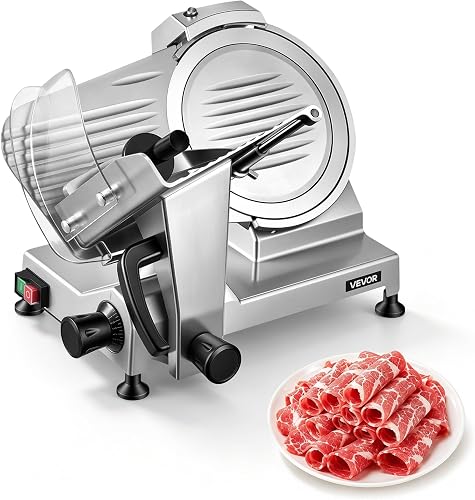
The VEVOR 8.6 inch suits buyers who slice frozen meat, ham and steak on a regular basis. The larger blade gives more cutting surface than a 7.5 inch model, and at 14 pounds it stays planted during longer sessions.
Its 200W motor runs at 70 to 100 RPM for smooth, steady slicing of firmer foods. Dual stainless steel blades include an 8.6 inch serrated blade and a non-serrated blade, with thickness from 0 to 0.6 inches.
The dual security lock, food pusher and suction cup feet help keep the machine stable. The blade, pusher and slide bar extender are removable, and the reversible meat tray lets you wipe down the unit between foods.
The trade-off is size and weight. At over 18 inches long, it needs more space than compact models, and it is hand wash only.
VEVOR Commercial Meat Slicer: Best for heavy home use
- 240W motor at 350-400 rpm
- 10 inch carbon steel blade
- 0 to 0.47 inch thickness adjustment
- Built-in sharpening stone
A 10 inch commercial style slicer with a chromium-plated steel blade, built-in sharpener and a food pusher with raised spikes.
Pros
- 10 inch blade for larger cuts
- Built-in sharpening stone
- Higher motor speed for quick slicing
Cons
- 34 pounds and large footprint
- Hand wash only
The VEVOR Commercial 10 inch suits a home that slices often in large batches. It is built like a shop slicer, and the 18 by 14 by 15 inch footprint and 34 pound weight mean it works best in a fixed spot.
Its 240W motor at 350 to 400 rpm slices quickly through frozen, raw and cooked meats and hams. The 10 inch chromium-plated carbon steel blade has a wider cutting surface, and a built-in sharpening stone helps keep the edge sharp.
Thickness adjusts from 0 to 0.47 inches for thin deli slices to thicker cuts. The food pusher has raised spikes and non-slip feet, and removable parts and a stainless steel tray wipe down easily after slicing.
The trade-off is weight and footprint. You need a fixed spot and a cabinet that can hold the height, and it is hand wash only.
VEVOR Meat Slicer: Best compact 7.5 inch home slicer
- 200W motor at 70-100 RPM
- 7.5 inch stainless steel blades, two included
- 0 to 0.6 inch thickness adjustment
- 1 mm recessed blade and suction feet
A compact 7.5 inch slicer with two blades and a reversible tray, sized for cabinets and counters where space is tight.
Pros
- Compact 8.4 pound size
- Two blades included
- Recessed blade for safety
Cons
- Hand wash only
- Smaller blade than the 8.6 inch VEVOR
The VEVOR 7.5 inch suits buyers who want 200W performance in a smaller body. At 8.4 pounds, it is easier to store than most countertop slicers, and its size fits many cabinets where larger models will not.
Its two 7.5 inch stainless steel blades include serrated and non-serrated options. The serrated blade handles frozen meat, deli items, steak, ham, carrots and potatoes, while the smooth blade handles softer foods such as bread and cheese.
Thickness adjusts from 0 to 0.6 inches, and a 1 mm recessed blade, food pusher and suction cup feet support safer use. The blade, pusher and slide bar extender are removable, and the reversible tray helps with wipe downs.
The trade-off is the smaller blade. Large roasts may need trimming, and it is hand wash only.
Borlebbi Meat Slicer: Best for die-cast durability
- 200W motor
- Two removable 7.5 inch stainless steel blades
- 0 to 15 mm thickness adjustment
- Die-cast aluminum body
A 200W slicer with two stainless steel blades, a stainless steel tray and a die-cast aluminum body that fits most cabinets.
Pros
- Die-cast aluminum body
- Two blades for different foods
- Stainless steel tray holds slices
Cons
- Hand wash only
- No dual blade type described as serrated
The Borlebbi suits buyers who value a durable body and simple features. The die-cast aluminum body is rustproof and easy to wipe down, and at 10.7 pounds it sits between compact and commercial models.
Its 200W motor and two removable 7.5 inch blades handle meat, cheese, fruits and vegetables. Thickness adjusts from about 0 to 15 mm, and the stainless steel tray holds sliced food as it comes off the blade.
Suction cup feet keep the slicer stable, and the food pusher acts as a blade guard. The blade, food carriage, slide rod extension and pusher are removable for thorough cleaning, and the compact design fits most cabinets.
The trade-off is hand wash only care and fewer safety details than some rivals. Check the 14.17 inch length against your cupboard depth before you buy.
BESWOOD 10" Electric Deli Meat Slicer: Best for cheese and deli platters
- 240W motor
- 10 inch chromium-plated steel blade
- Serving plate included
- Double illuminated ON/OFF switch
A 10 inch slicer with an aluminum body, removable serving plate and top-mounted sharpener, for meat, cheese, veggies and fruit.
Pros
- Serving plate included
- Aluminum body
- Chromium-plated blade resists corrosion
Cons
- 33 pounds and 20 inches long
- Hand wash only
The BESWOOD 10 inch suits buyers who slice cheese and deli items for platters and gatherings. The included serving plate simplifies serving, and the royal red aluminum body stands out.
Its 240W motor and 10 inch chromium-plated steel blade slice meat, cheese, veggies, ham and fruit with precision. The blade resists corrosion and frequent sharpening is not needed, while a top-mounted sharpener with two stones helps maintain the edge.
The double illuminated ON/OFF switch runs at 24V, and skidproof rubber feet plus a blade ring guard support safer use. The removable serving plate and product table make cleaning easier.
The trade-off is size. At 33 pounds and 20 inches long, this is a fixed-counter machine, and it is hand wash only.
OSTBA Electric Meat Slicer with Two 6.7”: Best for small counters
- 150W motor
- Two 6.7 inch stainless steel blades
- 0 to 15 mm thickness adjustment
- Dishwasher safe removable parts
The smallest countertop option here, with two 6.7 inch blades and removable dishwasher safe parts for easy cleaning.
Pros
- Smallest footprint here
- Lightest countertop model at 6.3 pounds
- Dishwasher safe parts
Cons
- 150W motor has less power
- 6.7 inch blade limits large cuts
The OSTBA 6.7 inch suits small counters and first-time slicer owners. At 6.3 pounds, it is the lightest countertop model here, and its footprint is the smallest in this group.
Its 150W motor and two 6.7 inch stainless steel blades handle deli meats, cheeses, bread, fruits and vegetables. The serrated and non-serrated blades let you match the blade to the food.
Thickness adjusts from 0 to 15 mm, so the same dial covers thin sandwich slices and thicker bread slices. Removable, dishwasher safe parts simplify cleanup, and suction feet plus a food pusher blade guard support safer use.
The trade-off is power and blade size. The 150W motor and 6.7 inch blade limit tough frozen batches and large roasts.
FOHERE 250W Electric Meat Slicer Machine: Best for jerky and varied foods
- 250W motor
- Three 7.5 inch stainless steel blades
- 0 to 15 mm thickness adjustment
- Die-cast aluminum body
A 250W slicer with two serrated blades and one smooth blade, built for meat, jerky, cheese, bread and vegetables.
Pros
- Highest power in this group at 250W
- Three blades included
- Compact die-cast aluminum body
Cons
- Slower blade speed for machine protection
- Dishwasher safe parts still need drying
The FOHERE 250W suits buyers who want extra power and more blade options in a compact body. It has the strongest motor here at 250W, and its size still fits most cabinets.
Its three 7.5 inch stainless steel blades include two serrated blades and one smooth blade. That set helps separate raw and cooked foods, and thickness adjusts from 0 to 15 mm for vegetables, meat, roasts, bread and more.
The slicer handles meat, jerky, cheese, bread and vegetables. A die-cast aluminum body resists rust and wipes clean, and suction feet and a food pusher help keep hands safe.
The trade-off is blade speed. The blades run slower for better cutting results and longer machine life, so slicing takes a steady pace, and dishwasher safe parts still need drying.
How do these electric meat slicers compare side by side
| Product | Best for | Blade Length | Blade Material | Item Weight | Our score |
|---|---|---|---|---|---|
| NutriChef Electric Carving Turkey Slicer Kitchen Knife | holiday carving | 5 inches | Stainless Steel | 2.7 pounds | 9.7 |
| OSTBA Electric Meat Slicer with Two 7.5” | deli meat at home | 7.5 inches | 8.6 pounds | 9.7 | |
| VEVOR Meat Slicer | frozen meat and ham | 8.6 inches | 14 pounds | 9.6 | |
| VEVOR Commercial Meat Slicer | heavy home use | 10 inches | 34 pounds | 9.5 | |
| VEVOR Meat Slicer | compact 7.5 inch home slicer | 7.5 inches | 8.4 pounds | 9.4 | |
| Borlebbi Meat Slicer | die-cast durability | 7.5 inches | 10.7 pounds | 9.2 | |
| BESWOOD 10" Electric Deli Meat Slicer | cheese and deli platters | 10 inches | 33 pounds | 8.9 | |
| OSTBA Electric Meat Slicer with Two 6.7” | small counters | 6.7 inches | 6.3 pounds | 8.6 | |
| FOHERE 250W Electric Meat Slicer Machine | jerky and varied foods | 7.5 inches | 16.33 x 10.63 x 9.84 inches | 8.1 |
For a quick side by side view of power and size, the table above puts the 9 models in score order. The NutriChef leads on portability, while the VEVOR Commercial and BESWOOD lead on blade size and power.
The OSTBA 6.7 inch is the smallest countertop option, and the FOHERE has the highest wattage.
How to read blade size against motor power
Blade size sets the maximum width you can slice in one pass. Motor power helps the blade keep speed through firmer foods.
A 7.5 inch blade with 200W suits most deli meats and cheeses, while a 10 inch blade with 240W suits larger roasts and frequent batch work.
Weight also changes how you use a slicer. Models under 10 pounds can move to a cabinet after use.
Models over 30 pounds work best in a fixed place where moving them is rare. That practical difference often matters more than a small power gap.
How we compared these models
We compared specs from the product data for each model, including blade size, blade material, motor power and thickness range. We checked which models include two blades, which parts are removable, and which models are hand wash only or dishwasher safe.
We also noted weight and dimensions, because storage decides whether a slicer gets used.
We did not test these machines hands on. Scores reflect how well the specs and features match the search for an electric meat slicer for home use.
Buyer patterns in the data helped us weigh safety features, cleaning and ease of storage.
Why cleaning and care changed the scores
Dishwasher safe removable parts reduce friction after each use, especially for the OSTBA models. Hand wash only models such as the VEVOR and BESWOOD machines require more time and drying space.
That difference affects how often owners will use the slicer for a quick sandwich.
Safety features also varied across the group. Dual locks, recessed blades and food pushers reduce risk during slicing.
Suction feet and skidproof feet keep the machine stable. Models with fewer listed safety details scored lower for everyday home use.
What blade size should you choose for home use
A 7.5 inch blade is the sweet spot for most homes. It slices deli meat, cheese and roasts well and still fits in a cabinet.
Models such as the OSTBA 7.5 inch, VEVOR 7.5 inch and Borlebbi all use this size.
Blade diameter also affects how you prep food before slicing. Smaller blades need trimming of large roasts.
Larger blades accept wider pieces but need a larger machine body. Match the blade to the largest food you slice most often, not the largest food you slice once a year.
When a 6.7 inch blade is enough
The OSTBA 6.7 inch model suits small counters and lighter slicing tasks. It is the best fit if you slice deli meat for one or two sandwiches at a time.
Large roasts will need trimming to fit the smaller blade.
The 6.7 inch size also keeps the whole machine light at 6.3 pounds. That weight makes it easier to lift into a cabinet and easier to clean in a sink.
For apartments and small galleys, that ease can outweigh a larger cutting width.
When a 10 inch blade makes sense
A 10 inch blade suits large roasts, cheese wheels and frequent batch slicing. The VEVOR Commercial and BESWOOD models use this size, but both weigh over 30 pounds.
Choose this size only if you have a fixed counter spot.
The wider blade also reduces the number of passes for large pieces. That speed helps when you slice for a crowd.
The cost is cabinet height and counter depth, so measure both before you commit to this size.
How thick can you slice deli meat and cheese
Most countertop models here adjust from 0 to about 15 mm. That range covers paper-thin sandwich slices and thicker roast slices.
Set the knob, test one slice, then adjust before you slice the whole piece.
Thickness control works best with a steady feed speed. Pushing too fast can create uneven slices even with a good blade.
Use the food pusher, keep your pace even, and let the blade do the work.
What thickness works for sandwiches
Start at the thin end for deli meat and cheese. Thin slices stack well and melt faster on warm sandwiches.
Use the food pusher and move the food at a steady pace for even results.
Thin slices also reveal blade condition. If slices tear or fold, the blade may need cleaning or a different blade type.
A serrated blade often handles deli meats more cleanly than a smooth blade.
What thickness works for roasts and jerky
Thicker settings near 5 to 10 mm suit roasts and jerky. For jerky, partially freeze the meat first so the blade holds the thickness steady.
Our guide to how to use a meat slicer machine walks through the full process step by step.
For roasts, a thicker slice keeps the meat juicy when served warm. Test one slice and check the texture before you slice the full piece.
That test saves time if the setting is still too thin or too thick.
How do you clean and store a meat slicer safely
Wipe the tray and slide bar after each use and wash removable parts before storage. Check whether parts are dishwasher safe or hand wash only, because that rule differs by model.
Dry blades well to help prevent rust.
Cleaning order matters for safety. Unplug the machine, remove the blade guard or pusher, then remove the blade and carriage.
Wash each part, dry it fully, and store it with the pusher in place where possible.
Store the slicer with the blade guard or pusher in place where possible. Suction feet models should be stored with feet clean and dry so they grip next time.
Compact models such as the VEVOR 7.5 inch fit cabinets more easily than 10 inch models.
Storage for small kitchens
Small kitchens should favor models under 9 pounds and under 16 inches long. The OSTBA 6.7 inch and VEVOR 7.5 inch fit that profile in this group.
Measure cabinet height and depth before you buy, because a slicer that fits on the counter may not fit in storage.
A portable knife such as the NutriChef stores in a drawer with its wooden stand flat. That option suits homes where a countertop machine would stay in a box.
Storage ease is a real performance factor for home use.
Which slicer is best for jerky and small spaces
For jerky, a serrated blade and steady thickness control matter most. The FOHERE 250W and VEVOR models include serrated blades for firmer meat.
See our picks for the best meat slicer for jerky if jerky is your main job.
Jerky also benefits from a machine that holds thickness at mid range settings. Partial freezing helps, but a stable carriage and pusher help more.
Test the setting on a small piece before you slice a full batch for drying.
For small spaces, look at the OSTBA 6.7 inch and VEVOR 7.5 inch first. If counter space is very tight, our best small electric meat slicer guide lists models built for compact kitchens.
A portable knife such as the NutriChef also works when a countertop machine will not fit.
Choosing between power and footprint
Higher wattage such as 250W helps with firmer meat and larger batches. A smaller footprint such as the OSTBA 6.7 inch helps with storage and daily setup.
Decide which limit you hit first in your kitchen, because that limit will shape your choice more than any single spec.
What about canning and storage after slicing
Freshly sliced meat and cheese need prompt refrigeration or freezing. If you plan to store sliced food long term, you may also want to look at canning gear.
Our best electric pressure canner guide and electric water bath canner guide cover those options, and our best commercial meat slicer guide helps if home models feel too small.
Label sliced foods with the date and use refrigerated deli meats within a few days. Frozen slices should be packed flat so you can break off what you need.
That simple step keeps sliced food from becoming a freezer block.
Our verdict on the best electric meat slicer for home use
Pick the OSTBA 7.5 inch for deli meat at home if you want a balanced countertop slicer. Pick the NutriChef knife for holiday carving if storage and table carving matter most.
For large batches, the VEVOR Commercial 10 inch and BESWOOD 10 inch add power and blade size at the cost of weight and space. For the smallest counter, choose the OSTBA 6.7 inch, and for jerky, the FOHERE 250W gives power and three blades in a compact body.
Start with the job you do most, then match blade size and power to that job.
Our top 3 picks at a glance
-
1
Best for holiday carving
NutriChef Electric Carving Turkey Slicer Kitchen Knife
9.7/10 our score
See it on Amazon -
2
Best for deli meat at home
OSTBA Electric Meat Slicer with Two 7.5”
9.7/10 our score
See it on Amazon -
3
Frequently asked questions
What is the best electric meat slicer for home use?
For most homes, a 7.5 inch countertop slicer with two blades gives the best balance of size and slicing range. The OSTBA 7.5 inch and VEVOR 7.5 inch models both adjust from thin deli slices to thicker cuts.
Choose the NutriChef knife only if you mainly carve whole roasts and turkey.
Can a meat slicer deli machine slice cheese and bread?
Yes, many home models use a serrated blade for harder foods and a smooth blade for bread and softer foods. Check which blades are included before you buy, because some include only one blade type.
Use the smooth blade for bread and the serrated blade for frozen meat or deli items.
What thickness should I set for deli meat?
Start near the thin end of the range for deli meat and test one slice before you slice the whole piece. Models here adjust from 0 to about 15 mm, so thin settings suit sandwiches and thicker settings suit roasts.
The food pusher helps keep slices even at thinner settings.
Are countertop slicers hard to clean?
Cleaning is easier when the blade, food carriage and pusher are removable. Most models here have removable parts, and some parts are dishwasher safe while others are hand wash only.
Wipe the tray and slide bar after each use and wash removable parts before storage.
Which slicer is best for jerky?
For jerky, look for a slicer that handles firmer meat and holds thickness steady at about 3 to 6 mm. The FOHERE and VEVOR models include serrated blades for firmer foods and adjust across the full 0 to 15 mm range.
Partially freezing meat first also helps you get even jerky slices.