How Long Does Cooked Vacuum Sealed Meat Last?
Cooked vacuum sealed meat lasts 3 to 4 days in the fridge and 2 to 3 months in the freezer at peak quality, though safe storage times differ. Cooling it fast, sealing it airtight while cold, and keeping it at 40°F or below in the fridge or 0°F or below in the freezer gives you the longest safe window.
On this page (9 sections)
- How Long Does Cooked Vacuum Sealed Meat Last in the Fridge?
- How Long Does Cooked Vacuum Sealed Meat Last in the Freezer?
- How Does Cooked Meat Differ From Raw Vacuum Sealed Meat?
- What Handling Steps Keep Cooked Meat Safe Longer?
- How Do You Seal Cooked Meat Without a Weak Seal?
- How Do You Thaw and Reheat Cooked Vacuum Sealed Meat Safely?
- What Signs Mean You Should Throw It Out?
- How Long Does Cooked Vacuum Sealed Deer Meat Last?
- How Long Does Cooked Vacuum Sealed Meat Last: Final Rules to Follow
Cooked vacuum sealed meat lasts 3 to 4 days in the fridge and 2 to 3 months in the freezer for best quality. Vacuum sealing removes air, but it does not make cooked meat last for weeks in the fridge.
The safe answer depends on how fast you cooled the meat, how cold you stored it, and whether the seal stayed intact. For more detail on cold storage alone, see how long vacuum sealed meat last in fridge in our related guide.
How Long Does Cooked Vacuum Sealed Meat Last in the Fridge?
Plan on 3 to 4 days in the fridge at 40°F or below. That window matches standard guidance for cooked meat, and vacuum sealing does not extend it as much as many cooks hope.
Removing air slows some spoilage and oxidation, but it does not stop bacteria that need little oxygen. Some bacteria can still grow slowly in a cold, sealed pouch.
Cool the meat fast before sealing. Put cooked portions in a shallow container, refrigerate them within 2 hours, and move them into a vacuum pouch once they reach 40°F or below.
Sealing hot meat can weaken the seal and create extra moisture.
If you sealed meat that had already sat out too long, the clock started before sealing. Vacuum sealing cannot undo time spent in the danger zone between 40°F and 140°F.
What temperature should your fridge stay at?
Keep the fridge at 40°F (4°C) or below and use a fridge thermometer. The back of the fridge is often colder than the door, so store meat toward the back when space allows.
Check the temperature after you load a large batch of sealed pouches. Warm food can raise the fridge temperature for several hours.
Cool cooked meat first and add it in smaller batches if you notice the temperature climbing.
If your fridge runs warm, cooked meat will spoil faster even in a tight vacuum pouch. A thermometer tells you more than how cold the food feels to the touch.
How Long Does Cooked Vacuum Sealed Meat Last in the Freezer?
Plan on 2 to 3 months in the freezer for best flavor and texture. At 0°F or below, frozen cooked meat stays safe much longer, but quality still fades with time.
Freezing pauses bacterial growth, so freezer limits are mainly about taste, texture, and freezer burn. Vacuum sealing helps by removing air that can dry the surface.
For more on frozen storage, see how long does vacuum sealed meat last frozen below.
Fatty meats, gravy, and sauces may turn stale sooner than lean meats. Label every pouch with the cut, cook date, and freeze date.
How Does Cooked Meat Differ From Raw Vacuum Sealed Meat?
Cooked meat has a much shorter fridge life than raw meat. Raw vacuum sealed meat often lasts 1 to 2 weeks refrigerated, while cooked meat lasts 3 to 4 days.
Cooking kills many bacteria, but slicing, shredding, and portioning can add new bacteria afterward. The pouch protects the meat after that point, but it cannot erase that new exposure.
Raw meat also gets a final kill step when you cook it after storage. Cooked meat is ready to eat, so there is no extra step to make it safe again.
Do not use raw meat storage times for leftovers. Our guide on What Exactly Does Vacuum Sealed Mean for Home Cooks? explains what a seal can and cannot do.
What Handling Steps Keep Cooked Meat Safe Longer?
Cool it fast, keep it cold, and seal it clean. Those three steps do more than any setting on your sealer.
Wash your hands before handling cooked meat after cooking. Use clean utensils for slicing and portioning, and keep cooked meat away from raw meat in the fridge.
Use a clean, dry pouch and leave enough space at the top for a strong seal. Wipe the inside lip dry before sealing, since juices near the seal cause weak seals.
Seal the meat once it is cold, not while it is steaming. Store sealed pouches flat so they cool faster, stack neatly, and thaw more evenly.
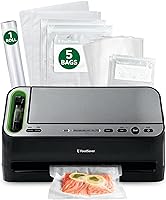
The FoodSaver V4400 2-in-1 Vacuum Sealer Machine includes an 11 inch x 10 foot roll, 3 quart bags, and 2 gallon bags, plus zipper bags. Its automatic moisture detection can help with juicy cooked meats, and the removable drip tray catches overflow.
FoodSaver says the system helps meat kept in the freezer last up to 3 years and still taste fresh for raw meat, but cooked meat still follows the shorter windows above.
How Do You Seal Cooked Meat Without a Weak Seal?
Leave headspace, dry the seal area, and seal only cold food. A weak seal is the most common reason a pouch fails early.
Fill the pouch no more than three quarters full. Extra food near the opening makes sealing harder and can puncture the bag in storage.
For soups, gravy, or saucy meat, freeze the pouch flat first, then seal the top once firm. Wipe the inside lip with a clean paper towel before sealing.
Check the seal for gaps, wrinkles, or trapped food. Do not reuse single-use vacuum pouches for cooked meat.
The Chef Preserve Compact Vacuum Sealer for Food comes with 30 reusable vacuum bags, 15 small and 15 medium. It is battery powered, wireless, and about the size of a pepper grinder, so it fits in a drawer rather than on a counter.
Chef Preserve says it seals a bag in under 5 seconds and that one charge can seal up to 1,000 bags. That speed helps with quick leftovers, but the same 3 to 4 day fridge limit still applies.
How Do You Thaw and Reheat Cooked Vacuum Sealed Meat Safely?
Thaw in the fridge or reheat from frozen to 165°F. Never thaw cooked meat at room temperature.
For fridge thawing, put the sealed pouch on a plate and allow about 24 hours. Flat packs thaw faster than thick ones.
Once thawed, eat the meat within 1 day. Do not refreeze it unless it stayed cold throughout thawing.
For reheating, use simmering water or remove the meat and heat it in a skillet, oven, or microwave. If reheating from frozen, add time and check that the center reaches 165°F with a food thermometer.
Open the pouch with clean scissors or a clean knife and transfer the meat to a clean plate. If you serve only part of a pouch, reseal the rest right away and keep it cold.
What if you only need part of a pouch?
Remove the portion, reseal the rest immediately, and return it to the fridge. Do not leave the open pouch on the counter while you set the table.
What Signs Mean You Should Throw It Out?
Discard it if the seal is broken, the pouch is puffy, or the meat looks or smells off. Do not taste it to check.
A puffy pouch can mean gas from bacterial growth. Sliminess, mold, or a sticky surface are also reasons to toss the meat.
Color change alone is not always spoilage, but color plus odor or texture change means discard. Check the seal before you rely on the date.
If the pouch has a hole, a gap, or food in the seal line, treat it like unsealed cooked meat. That means a shorter life and a closer look for spoilage.
When in doubt, throw it out. Write the seal date and use-by date on the pouch so you do not have to guess later.
Ziploc Quart Freezer Slider Bags come as 136 total bags in a 4-pack of 34 counts. The slider closure seals with a slide, and the film uses Power Shield technology to resist punctures and tears.
Ziploc notes the bags are made without BPA or phthalates. These bags are not vacuum bags, so expect a shorter freezer life and more freezer burn than with a true vacuum seal.
How Long Does Cooked Vacuum Sealed Deer Meat Last?
Treat cooked deer meat the same as other cooked meat: 3 to 4 days in the fridge and 2 to 3 months in the freezer. Field dressing and handling make fast cooling even more important for wild game.
Deer meat is often lean, so it can dry out faster after cooking and reheating. Seal it cold with as little extra air as possible, and consider adding a spoon of broth or sauce if the recipe allows.
For wild game storage times and handling notes, see how long does vacuum sealed deer meat last.
Keep cooked and raw deer meat separate and label pouches clearly. Seal cooked portions the same day you cook them.
How Long Does Cooked Vacuum Sealed Meat Last: Final Rules to Follow
Use 3 to 4 days in the fridge and 2 to 3 months in the freezer as your default plan. Those limits keep you safe and protect flavor.
Cool cooked meat within 2 hours, seal it once cold, and store it at 40°F or below in the fridge or 0°F or below in the freezer. Label each pouch with the meat type and seal date.
Pick the FoodSaver V4400 for large batches and custom bag sizes from a roll. Pick the Chef Preserve for a small handheld option with reusable bags for small portions.
Keep Ziploc Quart Freezer Slider Bags as a backup for freezing, but do not expect vacuum-level protection from a slider bag. Before your next batch, check fridge temperature and the seal line.
Frequently asked questions
How long does cooked vacuum sealed meat last in the fridge?
It lasts 3 to 4 days when cooled quickly and kept at 40°F or below. Vacuum sealing removes air, but it does not stop all bacteria.
Use the same short window you would use for unsealed cooked meat, and discard it sooner if it smells sour or feels slimy.
Can you vacuum seal hot cooked meat?
No, cool it first to 40°F or below before sealing. Hot food can soften seals, create moisture inside the pouch, and slow cooling.
Refrigerate the meat in a shallow container first, then portion and vacuum seal it once it is cold.
How long does cooked vacuum sealed meat last frozen?
It keeps best quality for 2 to 3 months in a 0°F freezer, and it remains safe longer if it stays frozen. Vacuum sealing limits freezer burn, but fat and seasonings can still change over time.
Label each pouch with the meat type and the freeze date before you store it.
What signs mean cooked vacuum sealed meat is bad?
Throw it out if the pouch is puffy, the seal is broken, or you see mold, sliminess, or color changes. A sour, sharp, or off smell after opening is also a sign to discard it.
When in doubt, do not taste it to check.