20 Cubic Foot Frost Free Upright Freezer: Right Size?
A 20 cu ft frost free upright freezer is right only if you regularly store a large, planned food load and have space for a tall cabinet: most households use it as a primary freezer for bulk meat, batch meals and seasonal stock. If your load is light or your floor space is tight, a smaller upright freezer will serve you better.
On this page (11 sections)
- Is a 20 cu ft frost free upright freezer the right size for your household?
- What does 20 cu ft mean in real food storage?
- How much floor space does a 20 cu ft upright freezer need?
- Is frost free worth it in a 20 cu ft upright freezer?
- Which household needs justify 20 cu ft?
- How does 20 cu ft compare with 7 cu ft and 5 cu ft?
- Which smaller upright freezers show the trade-offs?
- Can a 20 cu ft upright freezer work in a garage?
- How should you set up and care for a large upright freezer?
- What mistakes waste money on a 20 cu ft freezer?
- Should you buy a 20 cu ft frost free upright freezer or a smaller size?
A 20 cu ft frost free upright freezer is a large primary freezer, not a small overflow unit. It fits buyers who can name a big load they store at the same time, such as bulk meat, batch meals, garden produce or seasonal stock.
If you cannot name that load, start smaller. Capacity should follow a real food habit, not a hope for future use.
The smaller examples below help you judge the jump in size and what you gain or give up at each step.
Is a 20 cu ft frost free upright freezer the right size for your household?
It is right if your peak load fills a large cabinet and stays full for a reason. It is wrong if you want room for a vague future plan.
Count what you will store at your busiest point. Include meat, meals, bread, vegetables, ice cream and food already frozen when the next shop arrives.
Count packages, not just people.
A couple who batch cooks monthly may need more room than a larger family that shops twice a week and eats food quickly. Shopping frequency and package size decide more than household size alone.
List your largest load in meal containers, meat packs, vegetable bags and bread loaves. If that list would fill 5 to 7 cu ft, a 20 cu ft freezer will hold mostly empty shelves.
For a first check on freezer type and placement, read what type of freezer is best before you fix on capacity.
Firm rule: buy 20 cu ft only for a repeat, large food load you can list today.
How to list your peak freezer load
Start with food you must freeze on day one. Add food that will still be frozen when new groceries arrive.
That overlap is your real capacity need. Separate everyday items from seasonal peaks, and leave working room to move one group aside and reach the back shelf.
A smaller upright freezer fits if you store overflow beside a refrigerator freezer. It also fits in a tight kitchen, dorm, apartment or office where a tall cabinet would block a door.
The 3 cu ft and 7 cu ft examples below serve those homes, not as failed versions of 20 cu ft.
What does 20 cu ft mean in real food storage?
Twenty cubic feet means 20 cubic feet of interior volume, not a fixed number of meals or pounds. Flat bags pack tighter than bulky cartons, and shelves change what fits.
Think in categories you can sort, such as meat, meals, vegetables and bread. An upright helps because shelves let you see and reach each group.
That access is why many buyers choose upright over chest for daily use. A chest can hold more for its footprint, but you reach down and dig.
The trade-off is height. A 20 cu ft upright will be tall, so check that top shelves stay reachable.
Climate also matters, as a large freezer in a hot garage may not hold temperature if the model is not approved for that range.
How much floor space does a 20 cu ft upright freezer need?
It needs more than its footprint. Add ventilation gaps, door swing, delivery route and room to stand and load shelves.
Measure the path from the street to the final spot. Check doorways, hallways and turns against outside dimensions.
A tall freezer may not turn a tight corner even if it fits through the front door.
Tape the outline on the floor. Mark the door swing and the space where you will stand.
Try opening a door at that spot and bending to reach a low shelf.
Check overhead space for shelves, pipes and cabinets. Keep the back and sides clear for air flow as the manual requires.
Compare this with an upright freezer medium size guide if you are unsure between medium and large.
Measure the narrowest door and turn, then measure width, depth and height of the cabinet. Mark ventilation gaps and door swing, and leave standing room to load and unload.
Stand where you will use the freezer. Reach for the top shelf and the back of a middle shelf.
If reach is hard, a shorter cabinet may serve you better.
Is frost free worth it in a 20 cu ft upright freezer?
Frost free is worth it if you want less manual defrost work in a freezer you open often. It uses fans and heaters to manage moisture, so frost builds up less.
Manual defrost models keep the system simpler. They need periodic defrosting, and thick frost can reduce space and make cooling less efficient.
For some buyers, that chore is acceptable.
For a 20 cu ft freezer, the choice matters more. A large cabinet with thick frost loses usable space fast.
Frost free helps you keep shelves clear and food visible.
Look for a best frost free upright freezer roundup when you want more frost free options. Compare defrost type, shelf layout and outside size, not just capacity.
Frost free does not stop all ice. Door seals, warm food loads and frequent opening still add moisture.
Keep the door closed and avoid overpacking around vents.
Firm rule: choose frost free for low maintenance and clear shelves, not as a guarantee of zero frost.
Frost free trade-offs to weigh
Frost free adds parts that can fail and can use more energy than manual defrost. Manual defrost asks for your time and a plan to move food during defrost.
Pick based on use: daily family use favors frost free, while a rarely opened reserve freezer may suit manual defrost.
Which household needs justify 20 cu ft?
Needs that justify 20 cu ft include bulk buying, batch cooking, a garden harvest, or a large family with a clear storage system. Each need must be regular, not occasional.
Bulk buyers bring home meat and groceries in quantity. Batch cooks freeze meals for weeks.
Gardeners freeze produce in season. Each habit creates a peak load that a small freezer cannot hold.
A large family can justify 20 cu ft, but only if food turns over slowly enough to fill it. It can suit a family home with a utility room or basement, but not a small apartment or short term rental.
If your home has a garage spot, check garage suitability first. Our best frost free upright freezer for garage guide explains why ambient range matters more than capacity.
Light overflow, a second freezer for ice cream, a dorm or office, and a tight kitchen all point smaller. Write the load down and check that it truly fills the shelves.
How does 20 cu ft compare with 7 cu ft and 5 cu ft?
Twenty cubic feet is almost three times 7 cu ft and four times 5 cu ft. That jump changes the freezer from overflow to primary storage.
A 7 cu ft upright freezer can hold meal prep, meat and vegetables for a small household. A 5 cu ft model suits a couple or a light overflow load.
A 20 cu ft model suits a large reserve.
Footprint grows with capacity, but not in a straight line. Height, depth and shelf layout vary by model.
Always compare outside dimensions, not just cubic feet.
Access changes too. More shelves help you sort food, but top shelves in a tall cabinet can be hard to reach.
Measure reach before you choose the tallest option.
Our best 7 cubic foot upright freezer and best 5 cubic foot upright freezer roundups show the smaller bands in detail. Use them if your peak load list points below 10 cu ft.
Firm rule: step up in size only when your peak load list fills the smaller freezer.
Seven cubic feet suits meal prep, bulk groceries and overflow for many homes. Five cubic feet suits a couple or a second freezer.
Three cubic feet suits a dorm, office or apartment overflow, not a primary family freezer.
Which smaller upright freezers show the trade-offs?
The three examples here show compact, mid size and mini storage. They help you picture what smaller sizes offer and where they stop.
The Kismile has a 3.0 cu ft capacity in a compact cabinet that measures 20.3 in deep by 20.5 in wide by 31.7 in high. It has 2 removable shelves and a reversible door.
The thermostat range is -7.6 F to 6.8 F, with 1 as warmest and 7 as coldest.
Kismile says it uses 0.6 kilowatt hour per day and runs below 40 dB. The front mounted control, adjustable feet and built in top handle help in a dorm, RV, apartment or office.
It suits meat, seafood, ice cream and breast milk as overflow, not a large family reserve.
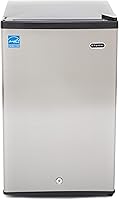
The Whynter CUF-301SS has 3.1 cu ft capacity and measures 21 in deep by 19.5 in wide by 33.5 in high. It has a stainless steel door, a reversible orientation and a removable slide out shelf.
It uses manual defrost for straightforward upkeep.
Whynter includes 2 keys for the lock. The lock helps in a dorm or shared apartment.
It suits compact frozen storage at home, not bulk family storage.
Use these minis as a check. If your load list fits in 3 cu ft, you do not need 20 cu ft.
If it overflows a 7 cu ft model by a wide margin, then 20 cu ft enters the search.
Firm rule: use smaller examples to test your load list before you size up to 20 cu ft.
Kismile, Whynter and Midea in brief
Choose the Kismile for a dorm, RV, apartment or office where floor space is tight. Choose the Whynter where shared space makes a lock useful, and accept manual defrost upkeep.
Choose the Midea 7.1 cu ft model when you need more room than a mini but less than 20 cu ft. It switches between freezer and refrigerator mode with one touch, runs in 0 F to 110 F for garage and basement use, and has 4 removable shelves, a reversible door and 360 degree cooling that drops temperature from 54 F to -0.4 F in 3 hours, according to Midea.
Can a 20 cu ft upright freezer work in a garage?
It can work in a garage only if the exact model is approved for your garage temperatures. Capacity does not make a freezer garage ready.
Garages swing from cold in winter to hot in summer. A freezer not rated for that range may run too often, fail to hold temperature or wear out early.
Check the approved ambient range before you place any freezer outside a climate controlled room.
For garage use, look for a best garage ready upright freezer guide and compare ambient ratings. The Midea 7.1 cu ft model above is a smaller garage ready design, with a stated range of 0 F to 110 F.
A 20 cu ft frost free upright freezer for a garage also needs ventilation and door swing. Tape the outline and keep those areas clear of cars, bins and tools.
Basements are often easier than garages because temperatures stay steadier. Still check the manual, keep the freezer level, and allow air to move around it.
Garage and basement checks before you buy
Confirm the ambient range, measure ventilation gaps, and keep the plug and controls reachable. Plan a thermometer check after setup.
For basements, check for damp and flooding risk, level the cabinet where fitted, and keep food away from the floor in case of water.
How should you set up and care for a large upright freezer?
Set up a large upright freezer with leveling, air flow and a thermometer. Those three steps protect food from day one.
Place the freezer on a level floor. Use adjustable feet where fitted.
Leave the gaps the manual requires on the back and sides. Do not push it tight against a wall to save space.
Let it cool before you load it. The Kismile guidance gives a useful general pattern: set the dial to 4 and allow 24 hours before you adjust.
For other models, follow the manual for that model.
Use a separate freezer thermometer. Numbered dials are not degrees.
Check that food stays at a safe frozen temperature and adjust from there.
Load food in categories on shelves. Keep vents clear so cold air can move.
Leave room for the door to close without forcing packages. Clean spills quickly and test that the door closes tight.
Put everyday items at eye and waist height, bulk items low, and light items high. Label shelves so anyone in the home can find food fast.
Wipe spills as they happen, check the door seal monthly, and clean the exterior where the manual directs.
What mistakes waste money on a 20 cu ft freezer?
The biggest mistake is buying 20 cu ft for a load that fits in 7 cu ft. You pay for space, floor area and energy you will not use.
A second mistake is skipping measurements. A tall, large freezer may not pass a turn, fit a gap or open fully.
Measure the route and the spot before you order.
A third mistake is ignoring ambient range. A freezer placed in a hot garage without approval can fail to hold temperature.
Check the range for the exact model.
A fourth mistake is poor loading. Overpacking blocks air flow and hides food.
Food at the back gets forgotten and loses quality.
A fifth mistake is treating a numbered dial as a temperature. Use a thermometer.
Adjust the dial based on actual food temperature, not on a number alone.
Compact buyers should also check a best compact upright freezer frost free guide. A compact model may fit a kitchen or office where a 20 cu ft cabinet cannot.
Should you buy a 20 cu ft frost free upright freezer or a smaller size?
Buy 20 cu ft if your repeat peak load fills a large cabinet. Buy smaller if your load fits in 5 to 7 cu ft or if floor space and reach are tight.
Write your load list. Write your floor outline.
Write your placement and ambient range. If all three point large, a 20 cu ft frost free upright freezer is a sound choice.
If your load list fits in a 7 cu ft model, choose that size and keep the extra floor space. If it fits in 3 cu ft, choose a mini for overflow.
The smaller freezer will be easier to place, reach and organize.
Frost free is a separate choice. Choose it for less defrost work and clear shelves.
Choose manual defrost for a simpler system and accept the upkeep.
In the end, an upright freezer frost free 20 cu ft is a tool for a large, planned storage habit. Name the habit, measure the spot and check the ambient range.
That test will tell you the right size without guesswork.
Firm rule: pick 20 cu ft only when load, space and placement all confirm a large freezer.
Frequently asked questions
Is a 20 cu ft frost free upright freezer too large for a family of four?
A family of four can use 20 cu ft if it does regular bulk shopping, batch cooking and large meat orders. If groceries arrive weekly in modest amounts and meals are used quickly, 5 to 7 cu ft in an upright freezer often fits daily life better than a 20 cu ft cabinet.
How much floor space does a 20 cu ft upright freezer need?
A 20 cu ft upright freezer needs a footprint plus ventilation clearance, door swing and standing room. Measure the doorway, delivery route and overhead space before you buy.
Tape the outline on the floor and check that you can open the door fully and reach every shelf.
Is frost free worth it in a large upright freezer?
Frost free helps when you open a large freezer often and want less manual defrost work. You trade simpler manual defrost models for fans and heaters that manage moisture.
Choose frost free if access and low maintenance matter more than the simplest possible system.
What is the difference between 20 cu ft and 7 cu ft upright freezers?
A 20 cu ft upright freezer holds almost three times the volume of a 7 cu ft model. That extra volume suits bulk storage and separation by food type.
A 7 cu ft model suits overflow, meal prep and smaller households with less floor space.
Should I buy a Frigidaire 20 cu ft upright freezer?
Check the exact model, outside dimensions, ambient range and door swing before you buy a Frigidaire 20 cu ft upright freezer. Brand alone does not confirm garage use or fit.
Compare the cabinet size with your largest planned food load and your available spot.